
001 | Bugs
You might find them if you flip over a cool rock

Imagine for a minute you’re the parent of a five-year-old daughter. It is dusk at the end of a fun-filled day: puzzle day at pre-K followed by a beetle hunt in the backyard and a family bike ride.
Later that evening, PJs on, you pick up her dress to put it in the laundry basket and out of the pockets fall a lime green plastic bead, a spotted feather (scraggly), a pebble that could be described as parallelogram-shaped, and the tuft of a paintbrush that has broken off the handle.
I am the kid. You are my parent. Here are some cool rocks I found this week.
TL;DR
Maybe see a new color you haven’t seen before (inconclusive)
An actual cool rock
We don’t know how to make a worm on the computer
An evergreen source, halvorz, shared this interesting essay by Chenchen Li who I now follow (yay!). I’m looking forward to part 2.

Chenchen writes here about scientific efforts to understand and model C. elegans worm brains, which have mostly not succeeded. And then about how, after failing to model all 302 worm neurons, some neuroscientists decided to take a crack at modeling the human brain’s 60-100 billion neurons instead. Did they succeed? You’ll have to read Chenchen’s essay to find out.1 There are also some hilarious quips from her nuclear engineer mother, if the worms were not sufficiently enticing on their own.
Japanese has way more alphabets than I realized
Okay. I don’t remember the source that sent me down this rabbit hole,2 but I discovered this week that Japanese has at least three different alphabets, that are often mixed not only in the same sentence but even within the same word. Wild stuff. The alphabets are called hiragana, katakana, and kanji — and you can learn all about them here. Hiragana is phonetic and looks more loopy,3 and is mostly used for writing native Japanese words. Katakana is ALSO phonetic (1:1 with hiragana) and looks more dash-y,4 and is mostly used for writing loan words adopted from other languages.5
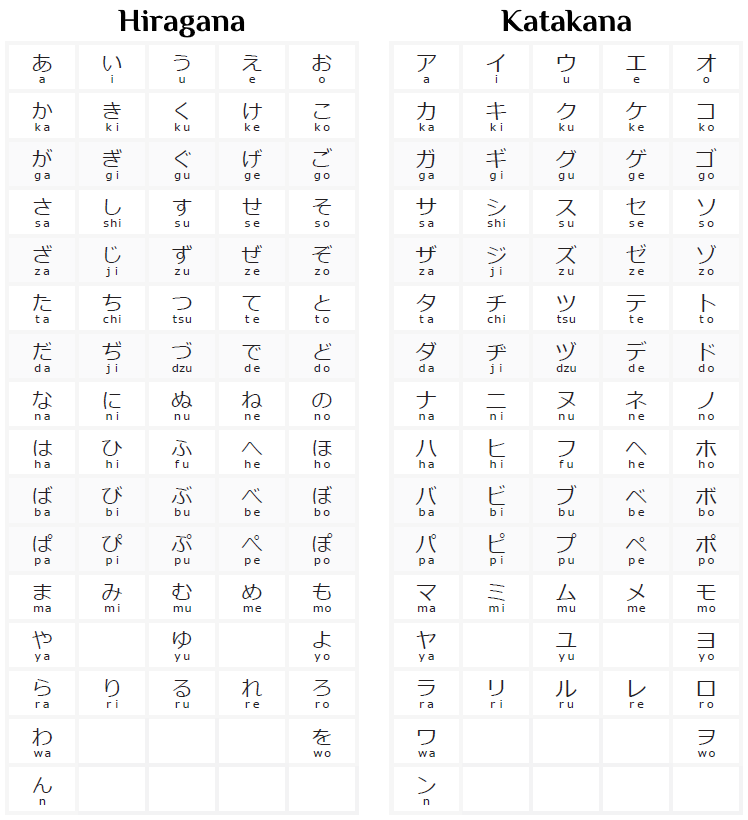
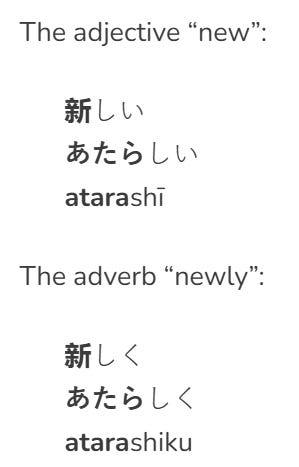
Then there are kanji, which are Chinese symbols adapted to Japanese, also used for native Japanese words. They’re not phonetic — each symbol represents a whole word — and they’re visually much denser. In practice, kanji are combined with hiragana for conjugation, mixing the two alphabets together in the same word! See below where the first line is kanji + hiragana, the second line is the same thing in hiragana alone, and the third line is “romaji”.
Learning all this made me want to learn Japanese but also highlighted just how hard that would be!
I saw a Bold Jumper
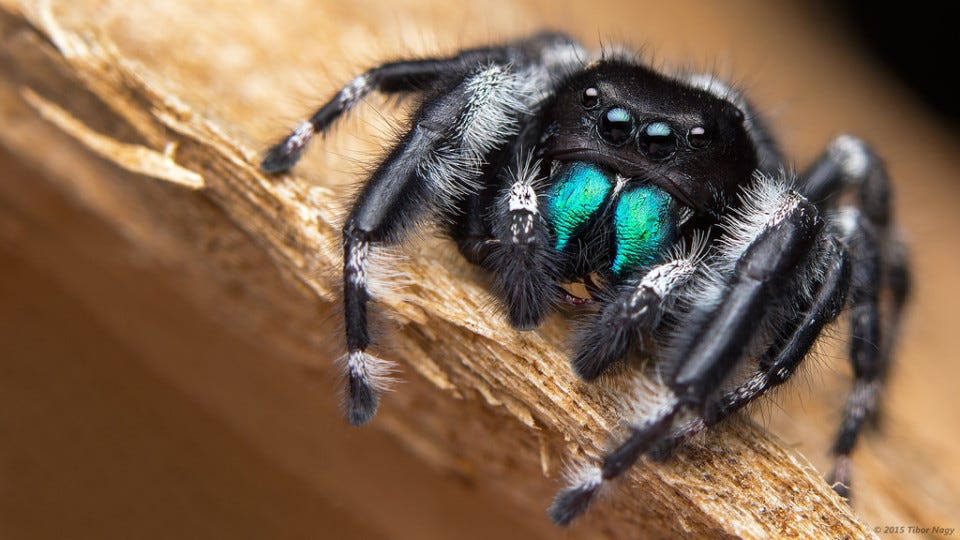
This past week I attended an offsite training for work near Dallas. During a session called ‘Managing Your Energy Bank’ we practiced going for a walk outside.6 During my walk I saw a bug about the size of my fingertip, clinging to a long stalk of grass. On closer inspection it was a fuzzy little black and white spider with bright blue mouthparts. I typed that into Google and found out it was called a Bold Jumping Spider or Phidippus audax. If you’ve ever tried to take an iPhone photo of a cool bug on a stalk of grass waving in the wind you’ll know that it’s impossible. But thanks to the internet I can show you what it looked like.
It seemed to be a bit afraid and was waving its front legs at me like this.
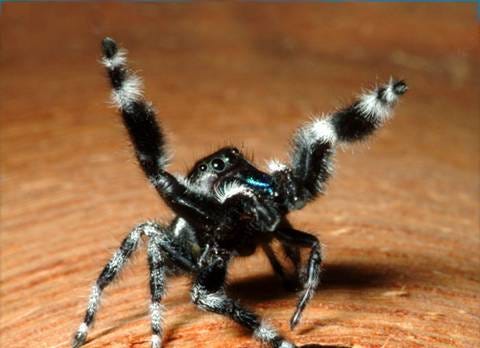
I spoke to the spider gently for a minute and it seemed to relax a bit. We looked into each other’s (many) eyes.7 The spider’s eyes were huge and iridescent — necessary for actively stalking and hunting its prey. Apparently, Bold Jumping Spiders are some of the most common spiders in the US (even though I’d never seen one before) and are helpful at keeping crop pest populations in check. Thanks little guys!
Maybe see a new color you haven’t seen before (inconclusive)
In April Fong et al. at UC Berkeley published a study using lasers to stimulate perception of a never-before observed color. At the time, my friend Katy Kelleher wrote this lovely piece about the mystery color.8
This week dynomight posted this great essay digging into the biology of how the new color is created, with a nifty optical illusion to sort of simulate it for yourself.

Probably not as intense of an experience as the one described in the study, but you can do it from the comfort of wherever you are right now instead of flying to California and begging James Fong to shine lasers in your eyes.
Jet Lag: The Game looks like my idea of a good time
On Friday I learned about the existence of Jet Lag: The Game thanks to this post (which is not about Jet Lag: The Game) by Ray Zhu. I then proceeded to spend a sizeable chunk of my afternoon watching these YouTube videos about the game. I want to play it SO BADLY.
Part 1:
Part 29:
Something to know about me is that I have been a fan of the reality TV competition show The Amazing Race since middle school. It’s essentially a scavenger hunt around the globe. Each episode teams of two interpret clues and complete challenges while backpacking their way from country-to-country. The last team to reach each leg’s ‘Pit Stop’ is eliminated from the race and at the end the winning team gets a million dollars. The Amazing Race has been running since 2001 and has 37 seasons so far!10 I would go on that show in a heartbeat.
Anyway. Jet Lag: The Game feels like a way more accessible version of the same flavor of thing. Who wants to play with me?
Singing Blame Brett makes for a fun 2m56s alter-ego
There’s pretty much no part of me that personally identifies with this song, but it’s fun to imagine being an emotionally irresponsible hazard for a couple minutes every now and then. Songs can be a type of fiction, and trying on someone else’s interiority is half of what fiction is good for.11
An actual cool rock
This is one of my favorite rocks anywhere in the world.
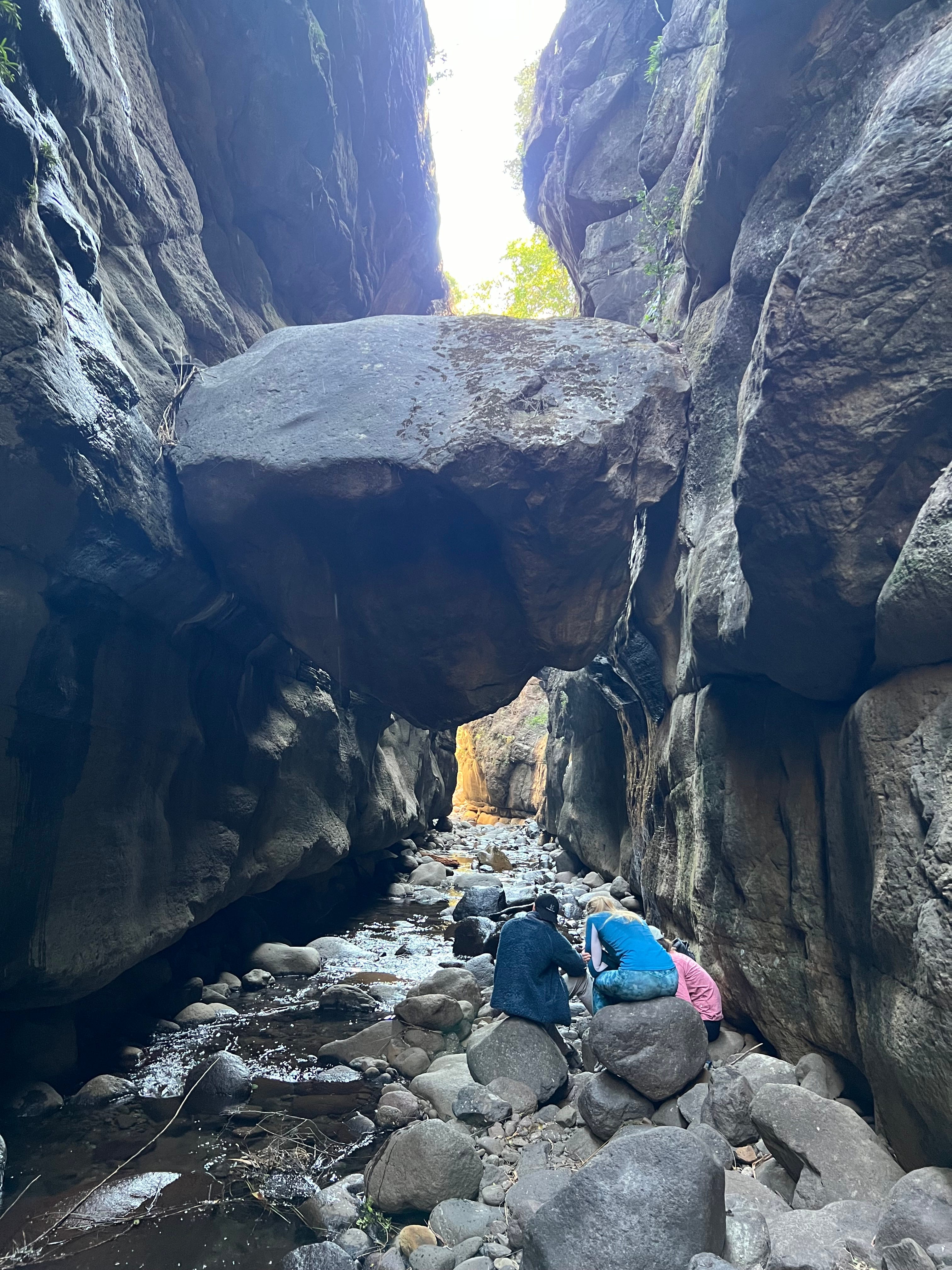
No need to touch grass when you can touch rock instead.

Rock on,
Taylor
Just kidding, of course they failed. But we got some (very expensive) pretty pictures out of it, so there’s that? You should read the essay anyway!
But I can describe it. Someone was VERY annoyed at YouTubers claiming to be polyglots able to speak 29 languages, and they wrote a whole piece about it. Along the way they mentioned knowing basic Japanese with a grasp of Hiragana and Katakana, and I was like “What are those?” so now we’re here.
Hiragana is bouba.
Katakana is kiki.
These cute smiley guys are katakana: ツ シ ヅ
I am 1000% serious. This was between learning box breathing (good, helpful) and ‘Exercise Snacks’ (2 squats whenever you visit the water cooler — what?).
Not a full 4 minutes, so we didn’t fall in love. Now that would have made for an interesting Modern Love submission.
I highly recommend Katy’s Substack Color Stories, and her book The Ugly History of Beautiful Things. We first connected on Twitter years ago before hanging out IRL in Santa Fe last summer. So much fun!
Whoever is first to find the bug reference in this video wins this issue of Cool Rocks.
You can find so many more details in the fan wiki, created by other people even more obsessed with the show than I am.
Erik Hoel has written some of my all-time favorite essays about this subject — The Future of Literature is Video Games, and Exit the Supersensorium.
Dying at these corporate productivity exercises.
When will they be brave enough to facilitate four minute eye gazing with the coworkers?